Awesome Way To Propose
Posted by Salraz in Interesting, Love, Video
0
comments »
Posted by Salraz in Christmas, Interesting
There are many things to dislike about Christmas: the bloated newspaper ads, the second-rate music repeated endlessly in shopping malls, the inane evangelical bleating that " "Jesus is the reason for the season"", and the pressure to conform lest you be labeled a Scrooge, or, even worse, a Grinch.
Of course, there are things to like about Christmas, too. Everybody enjoys giving presents, and some even like receiving them. A break from work is always appreciated -- even if, like me, you just use it to catch up on work left undone -- and a house that smells of roast turkey is one worth coming home to.
But there's one Christmas tradition that my wife and I have never shared: deceiving our kids about the real nature of Santa.
You know -- Santa Claus, Jolly St. Nick -- the man in the red suit who delivers the presents, as immortalized in the classic poem by Clement Clark Moore. (Shhh - don't tell the kids that Moore, a dour, humourless man who owned slaves and opposed abolition, probably stole the poem and its authorship from Henry Livingston.)
Ever year, Christmas offers adults the opportunity to participate in an absurd fraud against your own children: to pretend that Santa Claus is real, that he spookily monitors their behavior, that Santa won't bring them presents if they misbehave, and that he somehow manages to invade a billion houses in one night, aided by eight (or is it nine?) aviating ungulates.
I can already hear the howls of outrage. "It's a harmless fantasy," some will say. But it's not that harmless. Someday your Santa lie will be discovered. If you lied to them about Santa Claus, kids will wonder, what else did you lie to them about?
"It's only a little lie," others will say. But it's not so little. Once you lie about Santa's existence, you have to lie another time when your kids see Santa in two different stores. You have to lie once again when the kids leave Santa cookies before going to bed, and in the morning they're gone. It starts small, but it soon becomes an elaborate deception. We refused to play along.
I have nothing against fantasy stories. As a child, I loved the Lord of the Rings trilogy and read it over and over again. But it's important to know the difference between reality and fantasy. I never believed that Tolkien's Middle Earth was real, and my parents didn't lie to me that it was.
My wife and I never lied to our kids about Santa Claus. We treated him as a mythical figure, just like the the Easter Bunny and the Great Pumpkin.
Our kids don't seem to have been permanently harmed by our choice. Both like reading and telling stories, and they enjoy fantasy and role-playing games. The Narnia books are some of their favorites. They've even been known to wear Santa hats and play Christmas carols on their violins.
"You deprived them of a magical experience," some will say. I don't think so. Our kids know there is magic in the world, because they've looked through a microscope at a cell, and they've looked through a telescope at the rings of Saturn. They know that the tilt of the Earth's axis is the real reason for the season, but they also know the magic of their parents' love.
So no, Virginia -- Santa Claus isn't real. But there's nothing phony about human imagination, fantasy, the telling of tales, the complexity of our universe, the desire for a better world to live in, and our ability to achieve that world if we work hard enough and care about others. We told our kids the truth about those things, too.
Posted by Salraz in football, Odd, Police
Police brutality is a term used to describe the excessive use of physical force, assault, verbal attacks, and threats by police officers and other law enforcement officers. The term may also be used to apply to such behavior when used by prison officers. Widespread, systematic police brutality exists in many countries, even those which prosecute it.Brutality is one of several forms of police misconduct which include false arrest, intimidation, racial profiling, political repression, surveillance abuse, sexual abuse, and police corruption. (policebrutality)
Posted by Salraz in Birth, India, Interesting, Odd
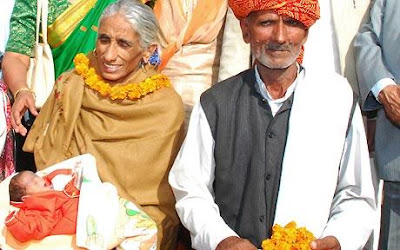
Rajo Devi, who married 50 years ago, gave birth to a baby girl on November 28, and is now thought to be the world's oldest new mother.
Dr Anurag Bishnoi, a doctor at the Hisar fertility centre in Haryana state, said: "Rajo Devi and (her husband) Bala Ram approached the centre for treatment and the embryo transfer was done on April 19.
"Both the mother and child are in good health."
A 67-year-old Spanish woman who had twins in 2006 was thought to have been the previous oldest mother.
Devi's husband, aged 72, had also wed his wife's sister after 10 years of his first marriage did not result in children. His second wife also failed to become pregnant.
It was not clear whose egg and sperm were used in the successful treatment.
Dr Bishnoi, who helped the couple realise their dream, said both the mother and child were in good health.
"IVF has revolutionised the way we look at infertility," said Mr Bishnoi. "Infertility is no longer a social taboo or a divine curse. It can be treated scientifically."
"Adriana Iliescu, a retired university lecturer in Romania, was the oldest woman to have given birth. She delivered at the age of 66 in 2006. Maria Del, a Spanish woman, gave birth by the IVF treatment at the age of 67. And now, Rajo Devi has become the oldest woman to have given birth and the first woman in her seventies to do so," claimed Dr Bishnoi.
"Another woman of her age is reported to have delivered a child at Muzzafarnagar, but she was previously fertile," he added.
New mother Rajo Devi, "We longed for a child all these years and now we are very happy to have one in the twilight years of our life."
Husband Ram said he wasn't worrying over who would look after the child if they died.
"The upbringing of the child is not a problem. We have a joint family as is common in rural Haryana," he said.
The couple said they were facing social stigma for being childless for the last 55 years.
"We used the usual intra cytoplasmic sperm injection (ICSI) technique in her case. The ICSI method enables even poor quality sperms being used creating embryos," said Dr Bishnoi.
He said his parents and wife, all doctors, performed the procedure together. "The major concern for us was that in case the woman conceived twins, she may not be able to carry them through the full term of pregnancy. In that case, all over efforts would have failed and the woman's life would have been in danger," Bishnoi said.
To avoid multiple pregnancies, the doctors used blastocyst culture, where a single potential embryo is transferred to the uterus instead of the normal two to three embryos. "This embryo is transferred after five days in this technique, while in normal cases it is done in two-three days," he added.
"Rajo is the eldest of four siblings. She is elder to me by about 16 years. We all prayed she would get a child and even married our other sister to Bala Ram in this hope. Now the whole family is very happy that she has a child," said Chand Ram, Rajo Devi's brother who is a sub inspector in Haryana Police at Panchkula.
Posted by Salraz in Fact, Interesting, Workers
Wearing dark sunglasses when outside in daytime and a strict sleep schedule can improve job performance and alertness in night shift workers, say researchers.
The research team revealed that use of light exposure therapy, dark sunglasses and a strict sleep schedule can help night-shift workers create a "compromise circadian phase position," which may result in increased performance and alertness during night shifts while still allowing adequate nighttime sleep on days off.
The study involved twenty-four healthy subjects with seven women and five men in both the experimental and control groups.
All subjects were young, but the experimental group was significantly older than the control group (average age of 28.9 years versus 23.7 years). Subjects did not work night shifts in the three months preceding the study and did not travel across more than three time zones in the month preceding the study.
During the research, subjects underwent a total of seven simulated night shifts from 11 p.m. to 7 a.m. with two days off. Experimental subjects slept in dark bedrooms at scheduled times: 8:30 a.m. to 3:30 p.m. after the first two night shifts, from 8:30 a.m. to 1:30 p.m. after the third night shifts, from 3 a.m. to 12 p.m. on the two weekend days off, and again from 8:30 a.m. to 3:30 p.m. after the final four night shifts.
They also were exposed to five, 15-minute, intermittent bright light pulses each night shift; wore dark sunglasses when outside; and received outdoor afternoon light exposure.
The performance of the experimental group was close to the level during day shifts, demonstrating fast reaction times with low variability and few or no lapses. In contrast, the control group continued to show longer and more variable reaction times on all night shifts.
The study suggests that in addition to adopting the recommended sleep pattern and wearing sunglasses, night-shift workers who use bright light exposure therapy will be able to alter their circadian rhythm in order to improve performance during night shift work, continue day-time interaction with peers and have the ability to sleep at night on days off.
The study appears in the journal Sleep.
Posted by Salraz in India, Mumbai, Terror
Late Wednesday night, Mumbai, India found itself the target of a ferocious terrorist attack, and the situation remains unresolved even now, three days later. According to reports, upwards of 60 young men entered Mumbai in small inflatable boats on Wednesday night, carrying bags filled with weapons and ammunition, and spread out to nine locations to begin their attacks. Lobbing grenades and firing their weapons, they entered hotels, a railway station and several other buildings, killing scores and wounding even more. As of this moment, the identity of the attackers has yet to be definitively determined, though there are reports indicating some of the gunmen were Pakistani - at least nine of them have been killed, nine more arrested. As of this writing, there were a reported 151 people killed from 11 different countries - though nearly 100 were Indian. More than 300 injuries have also been reported - those numbers may yet rise as several hostage situations still exist in the city. Onlookers stand at the site of a bomb blast in Mumbai November 26, 2008. (REUTERS/Stringer)
 A gunman walks through the Chatrapathi Sivaji Terminal railway station in Mumbai, India, Wednesday, Nov. 26, 2008. (AP Photo/Mumbai Mirror, Sebastian D'souza)
 A man carries a victim of a gun attack away from the scene of an earlier attack at the Chatrapati Shivaji Terminus in Mumbai, India, Wednesday, Nov. 26, 2008. (AP Photo/Rajanish Kakade)
 Armed gunmen are seen in the Chatrapathi Sivaji Terminal railway station in Mumbai, India, Wednesday, Nov. 26, 2008. Teams of gunmen stormed luxury hotels, a popular restaurant, hospitals and a crowded train station in coordinated attacks across India's financial capital, killing people, taking Westerners hostage and leaving parts of the city under siege Thursday, police said.
 A reporter talks on her phone as smoke is seen coming from Taj Hotel in Mumbai November 27, 2008. Large plumes of smoke were seen rising from the top of the landmark Taj Hotel in Mumbai on Thursday and heavy firing could be heard, a Reuters witness said. (REUTERS/Arko Datta)
 A member of the anti-terrorist squad takes a position during an engagement with suspected militants at the Taj Mahal Hotel in Mumbai, India, Friday, Nov. 28, 2008. (AP Photo/Rajanish Kakade)
 Firefighters try to douse a fire at the Taj Mahal Hotel in Mumbai November 27, 2008. Indian commandos freed hostages from Mumbai's Taj Mahal hotel on Thursday but battled on with gun-toting Islamist militants.
 The body of a terrorist attack victim is brought in an ambulance to the St. Georges Hospital in Mumbai, India, Thursday, Nov. 27, 2008. Dozens of people were still trapped or held captive Thursday.
 Employees and guests of the Taj Mahal hotel, site of one of the shootouts with terrorists, are recued by firefighters as fire engulfs the top floor on late November 26, 2008.
 Fire engulfs the top floor of the Taj Mahal hotel, site of one of the shootouts with terrorists in Mumbai on late November 26, 2008. (LORENZO TUGNOLI/AFP/Getty Images)
 Sharda Janardhan Chitikar, left, is consoled by a relative as she grieves the death of her two children in a terrorist attack while she waits for their bodies outside St. Georges Hospital in Mumbai, India, Thursday, Nov. 27, 2008.
 The windows on the first floor of the Taj Mahal hotel shatter after the use of a grenade launcher in Mumbai, India, Friday, Nov. 28, 2008. Explosions and gunfire continued intermittently at the Taj Mahal hotel Friday afternoon, two days after a chain of militant attacks across India's financial center left people dead and the city in panic.
Schoolchildren hold candles during a vigil held in memory of the victims of Wednesday's shootings in Mumbai, in the western Indian city of Ahmedabad November 27, 2008. Elite Indian commandos fought room to room battles with Islamist militants inside two luxury hotels to save scores of people trapped or taken hostage, as the country's prime minister blamed neighbouring countries. (REUTERS/Amit Dave) A National Security Guard (NSG) commando aims towards a window after an explosion on the fourth floor of the Nariman House where suspected militants are hiding, in Mumbai November 28, 2008. (REUTERS/Punit Paranjpe)
 A National Security Guard commando fires at suspected militants believed to be hiding in Nariman House, in Mumbai November 28, 2008. (REUTERS/Peter Keep)
